
Expressing opinions is not only a key skill for language exams but also a useful life skill. Some students struggle to overcome their fear of sharing their thoughts in front of their classmates, while others simply lack the language and support they need. Creating a comfortable environment where students feel safe to share their views, and giving them the right language, can make a big difference.
If you want to help your students express their opinions, display the useful phrases in your classroom or download the free phrase cards, and try out some of the practice activities. Help your students use the right language in the right situations.
1Why practise expressing opinions
Although expressing opinions is usually taught at B1–B2 level, learners at lower and higher levels can benefit from it too.
For A1–A2 learners, expressing opinions in a simple, straightforward way helps build fluency and gives them their first sense of success in speaking a foreign language in full sentences. Most importantly, typical topics at beginner and elementary levels relate to the learners' everyday lives: their home, hobbies, family, and other things they can easily talk about. Expressing opinions about what they know best, with enough language support, is not only easy but also highly motivating.
C1–C2 learners, on the other hand, can benefit from more advanced techniques, such as hedging, being polite when they disagree, and using formal language.
Explore our free worksheets on expressing opinions

2How to support students
Expressing opinions isn't just another grammar topic, so reading about it or completing textbook exercises might not be the best way to go. Instead, give students the support they need.
Create a safe atmosphere
First, create a warm, inclusive, and welcoming atmosphere, so that students aren't afraid to say something out loud. You can let some grammar mistakes go and help students express what they want to say in whatever way works for them at the moment.
Give them the language
Second, give students the right language support. Display or print out the phrases below and go through them together before the speaking task. You can also cut out the phrases and have students sort them into the right categories (e.g. agreeing, disagreeing, asking, and giving an opinion).
Give them time to prepare
Third, give students time to prepare. Not everyone is ready to start talking right away, so let students think about what they want to say before they speak. Set a topic or a question and use think-pair-share: students first think about what they want to say on their own, perhaps even write it down. Then they pair up and share their opinions with a partner. After that, they can speak in front of the whole class and give their own opinion or summarise what they discussed in pairs. This helps shy students feel more comfortable, and it gives weaker students time to prepare the language they need.
3Useful phrases
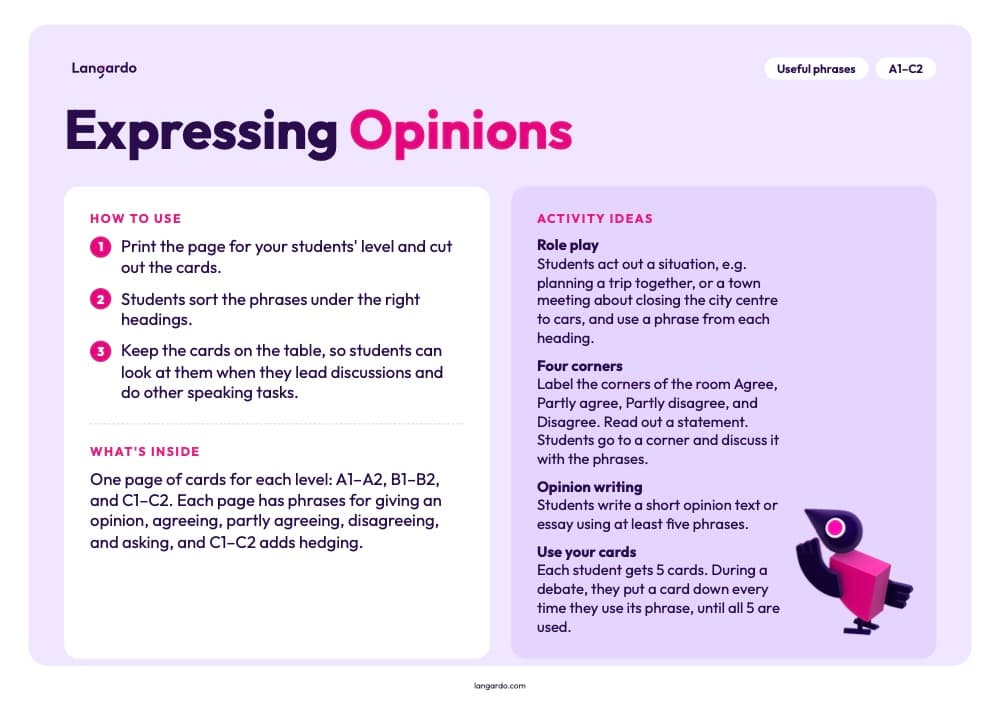
The PDF has phrase cards for three levels, one page each, and a page with tips on how to use them. Print the page for your students' level and cut out the cards.
A1–A2
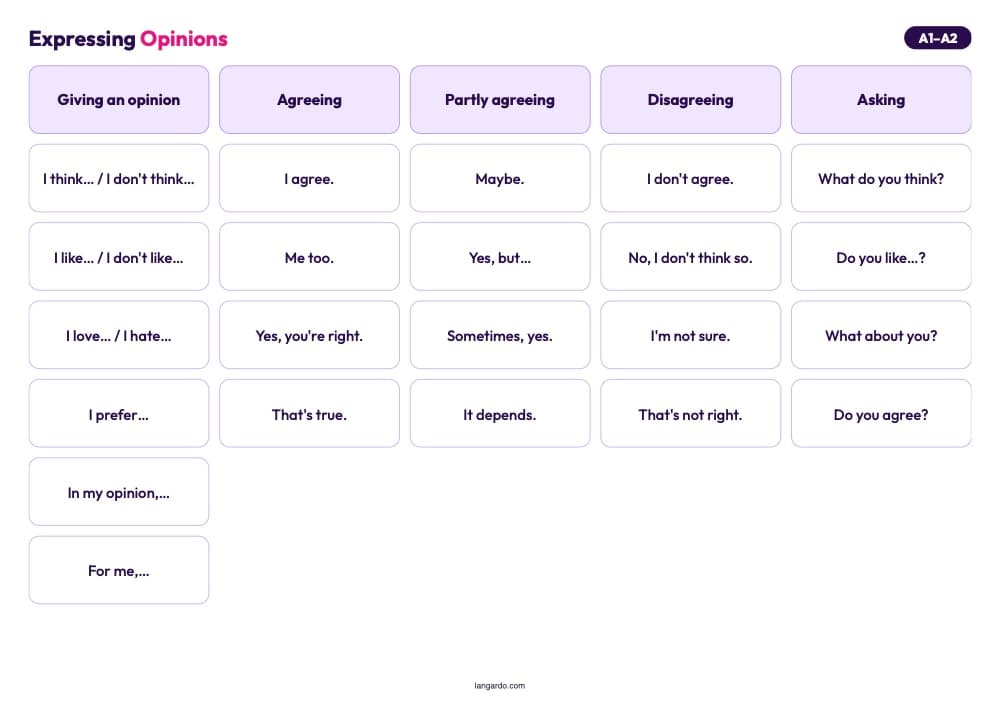
- Giving an opinion: I think… / I don't think…, I like… / I don't like…, I love… / I hate…, I prefer…, In my opinion,…, For me,…
- Agreeing: I agree., Me too., Yes, you're right., That's true.
- Partly agreeing: Maybe., Yes, but…, Sometimes, yes., It depends.
- Disagreeing: I don't agree., No, I don't think so., I'm not sure., That's not right.
- Asking: What do you think?, Do you like…?, What about you?, Do you agree?
B1–B2
- Giving an opinion: I believe…, I feel that…, In my view,…, As far as I'm concerned,…, Personally, I think…, If you ask me,…
- Agreeing: I completely agree., That's a good point., I couldn't agree more., Exactly!
- Partly agreeing: I agree up to a point, but…, You may be right, but…, I see what you mean, but…, That's true, but on the other hand…
- Disagreeing: I'm afraid I don't agree., I'm not so sure about that., I don't think that's right., I see it differently.
- Asking: What's your opinion on…?, How do you feel about…?, Do you agree that…?, What do you think about…?
C1–C2
- Giving an opinion: I'm inclined to think…, I'm convinced that…, From my perspective,…, I'd argue that…, It strikes me that…, I'm of the opinion that…
- Agreeing: I'm with you on that., You've hit the nail on the head., That's precisely my point., I couldn't have put it better myself.
- Partly agreeing: There's some truth in that, but…, I agree in principle, but…, I take your point, but…, That may be so, but…
- Disagreeing: I beg to differ., With respect, I'd see it differently., I'm not convinced., I'd take issue with that.
- Asking: Where do you stand on…?, What's your take on…?, How do you see it?, I'd be interested to hear your view on…
- Hedging: To some extent,…, I'd be tempted to say…, It could be argued that…, It's not quite that simple.
4Practice activities
Role play
Set a scene, choose the characters, and let students discuss a topic in pairs. Role plays are easy to prepare in advance or make up on the spot, and they fit almost any topic you cover in class.
Opinion essay
Set a writing task where students express their thoughts in an organised way and use the phrases. To help students feel comfortable with the topic, let them choose from two or three subtopics, so they can pick the one that's easiest for them to write about. Encourage them to use a clear structure, e.g. an introduction, arguments for, arguments against, and a conclusion.
Agree or disagree
Give each group a few statements that people often disagree about. Using the phrases, each student says how much they agree with each statement. Students can also form a line, where one end means I agree and the other means I disagree, and stand where their opinion is. Then they turn to the person next to them and discuss the topic.
Would you rather
Give students two options, ask them which one they would choose and why, and let them ask a partner for their opinion too. For example: drinking coffee or tea, hiking in winter or in summer, watching a film or reading a book, listening to music or playing music, staying in a hotel or in a tent.
Debate
Divide students into two groups and randomly decide which group agrees and which disagrees with a statement. Then present the statement or topic, give the groups time to prepare their arguments, and then lead the discussion.
Four corners
Give each corner of the classroom a meaning, e.g. agree, partly agree, partly disagree, and disagree. Read out a statement and let students walk to the corner that matches their opinion. The students in each corner discuss their reasons and then present them to the rest of the class.
Enjoy the lively discussions in your lessons!